All Color Formats
Get HEX, RGB, HSL, HSV, and CMYK values instantly for any color with one-click copy functionality.
Explore the complete information for Light Green color including hex, RGB, HSL, and CMYK values. Generate shades, tints, and discover harmonious color palettes.
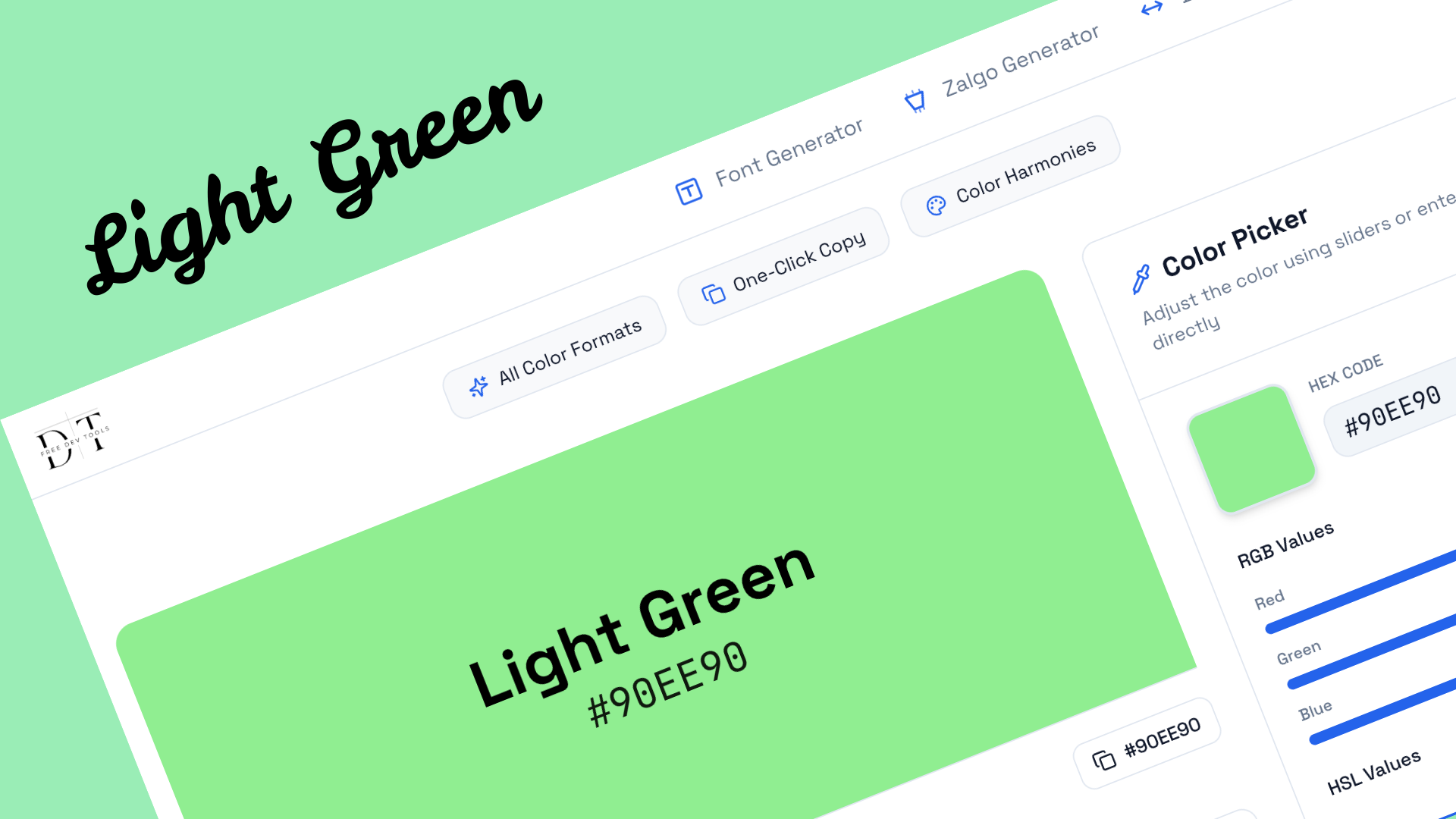
#90EE90
Light Green
Click the color above to copy hex code
Click any color to copy the hex code
Click any color to copy the hex code
Adjust the color using sliders or enter values directly
All color format conversions for easy use in your projects
HEX
#90EE90
RGB
144, 238, 144
HSL
120°, 73%, 75%
HSV/HSB
120°, 39%, 93%
CMYK
39%, 0%, 39%, 7%
CSS Variable Format
--color-primary: #90EE90;--color-primary-rgb: 144, 238, 144;Discover harmonious color combinations based on color theory. Click any color to copy its hex code.
Everything you need to work with colors - from format conversion to palette generation, all in one free tool.
Get HEX, RGB, HSL, HSV, and CMYK values instantly for any color with one-click copy functionality.
Generate 10 darker shades and 10 lighter tints of any color for creating cohesive color palettes.
Discover complementary, analogous, triadic, split-complementary, and tetradic color schemes.
Copy any color code to your clipboard with a single click. Works with all color formats.
See your color changes in real-time with our interactive color picker and sliders.
All processing happens in your browser. Your color choices are never sent to any server.
No loading times. All color conversions and calculations happen instantly.
Works perfectly on all devices. Pick and convert colors on your phone or tablet.
Use directly in your browser. No downloads, no sign-ups, just start using.
Everything you need to know about light green color and color tools
Light green, represented by the hex code #90EE90, stands as one of nature's most refreshing and versatile colors. This particular shade of green evokes feelings of spring growth, renewal, and vitality that have made it a cornerstone of design across countless industries. From website interfaces to interior design, from fashion to environmental graphics, light green brings a sense of freshness and life that few other colors can match. Our comprehensive color tool provides everything you need to work with this beautiful shade, including instant conversions between all major color formats, harmonious palette generation, and practical application guidance.
Light green occupies a fascinating position on the color spectrum. With a hue of 120 degrees, it sits precisely in the middle of the green family, neither leaning toward yellow nor blue. The saturation of 73% gives it enough vibrancy to stand out while maintaining its soft, approachable character. At 75% lightness, this particular shade achieves a perfect balance between being noticeable and being gentle on the eyes.
The RGB values of 144, 238, 144 reveal an interesting symmetry where the red and blue channels are identical, with green dominating at 238. This mathematical harmony contributes to the color's pleasing appearance and explains why it feels so balanced and natural to human perception.
Color psychology reveals that light green triggers powerful associations in the human mind. Research consistently shows that this color promotes feelings of calmness, balance, and harmony. Unlike darker greens that might feel serious or institutional, light green maintains an optimistic and fresh quality that puts viewers at ease while still commanding attention.
In digital interfaces, light green has proven particularly effective for success messages, confirmation buttons, and positive feedback. The color signals that everything is working correctly without creating the urgency associated with brighter greens. This makes it an excellent choice for applications where user comfort and extended engagement are priorities.
The hexadecimal value #90EE90 represents light green in web development. This six-character code is universally recognized across browsers, design software, and development frameworks, making it the go-to format for digital projects.
RGB(144, 238, 144) defines light green using red, green, and blue light channels. The high green value of 238 creates the dominant hue, while balanced red and blue values add warmth and prevent the color from appearing too artificial.
HSL(120°, 73%, 75%) provides an intuitive way to understand and modify light green. The 120° hue represents pure green, 73% saturation adds vibrancy, and 75% lightness keeps it airy and approachable.
For print applications, light green translates to approximately CMYK(40%, 0%, 40%, 7%). The absence of magenta maintains color purity, while low key values preserve brightness. Print colors may vary based on materials.
HSV(120°, 39%, 93%) shows light green with high value and moderate saturation. This format is particularly useful in design applications where adjusting brightness and color intensity is common.
Light green is one of the 147 CSS named colors, meaning you can simply use "lightgreen" in your stylesheets. This provides excellent readability in code while maintaining precise color reproduction.
Light green excels in web design as an accent color for success states, call-to-action buttons, and positive notifications. Its natural association with growth makes it perfect for progress indicators and achievement systems. Many financial applications use light green to indicate positive returns, while health and wellness platforms leverage its calming properties for meditation and relaxation features. The color's high visibility against both light and dark backgrounds makes it versatile across different design themes.
Brands centered on sustainability, health, or innovation frequently incorporate light green into their visual identity. The color communicates environmental consciousness without being as overwhelming as darker greens. In marketing materials, light green backgrounds create a fresh canvas that makes products appear clean and trustworthy. It works particularly well for organic food brands, eco-friendly products, and wellness services.
Interior designers appreciate light green for its ability to bring the outdoors inside. As an accent wall color, it creates focal points without overwhelming spaces. In bedrooms and bathrooms, it promotes relaxation and tranquility. Kitchen accents in light green pair beautifully with natural wood tones and white cabinets. The color also works excellently in home offices where concentration and calm are essential.
Light green has become a staple in spring and summer fashion collections. Its fresh appearance complements a wide range of skin tones, making it accessible for diverse audiences. In home textiles, light green bedding, curtains, and upholstery add vitality to neutral rooms. The color pairs elegantly with white, cream, soft pink, and navy blue for sophisticated combinations.
The classic combination that never fails. White amplifies light green's freshness while providing clean contrast. This pairing is perfect for minimalist designs, medical and health applications, and environmental messaging. The combination reads as clean, pure, and trustworthy across all applications.
This sophisticated combination balances light green's energy with navy blue's authority. It works exceptionally well for corporate applications that want to appear both professional and innovative. Financial services, consulting firms, and technology companies often employ this palette.
As complementary colors, light green and coral pink create vibrant visual interest. This tropical-inspired combination works beautifully for lifestyle brands, summer campaigns, and creative agencies. The contrast is eye-catching without being jarring.
Gold accents elevate light green to luxury territory. This combination is popular in premium organic products, high-end wellness brands, and exclusive spa environments. The warmth of gold complements green's coolness perfectly.
For modern, urban aesthetics, charcoal gray grounds light green's playfulness. This combination is excellent for technology products, contemporary furniture, and urban planning visualizations. It feels both natural and sophisticated.
Throughout history, green has held special significance across cultures. In ancient Egypt, green represented regeneration and the papyrus of the Nile. Medieval Europeans associated green with nature spirits and the rejuvenation of spring. Islamic tradition considers green sacred, frequently using it in mosque decorations and religious texts.
The modern environmental movement has further solidified green's association with ecology and sustainability. Light green, as a softer variant, carries these historical meanings while adding approachability and optimism. It represents not just nature, but hope for nature's preservation.
In Western cultures, green generally signifies growth, money, and nature. East Asian traditions often associate green with youth and new beginnings. Irish culture has particularly strong ties to green, though they typically favor deeper shades. Light green's softer tone makes it universally acceptable across these cultural contexts.
Understanding these cultural associations is crucial for global brands. Light green's gentle nature makes it less likely to trigger negative cultural responses while maintaining positive associations with health, nature, and renewal across diverse markets.
Light green (#90EE90) as a background color achieves excellent contrast with dark text. Black text on light green backgrounds produces a contrast ratio exceeding 15:1, well above WCAG AAA requirements of 7:1 for normal text. However, white text on light green fails accessibility standards with a ratio of only 1.39:1.
When using light green as text, ensure backgrounds are sufficiently dark. Navy blue, dark gray, or black backgrounds work well. Avoid placing light green text on white or light backgrounds, as the insufficient contrast can make content difficult to read for many users.
Approximately 8% of men and 0.5% of women have some form of color vision deficiency. Light green can be confused with yellow or brown by those with deuteranopia or protanopia. Always ensure important information isn't conveyed by color alone.
Use icons, patterns, or text labels alongside color indicators. For interactive elements, consider adding subtle animations or different shapes to distinguish states beyond color changes. Testing designs with color blindness simulators ensures accessibility for all users.
Light green can feel overwhelming in large doses. Balance it with white, gray, or cream to let it breathe and maintain visual harmony.
Create depth by using multiple shades of light green. Use darker shades for borders or accents and lighter tints for backgrounds.
Light green reads differently on screens versus print. Always proof physical materials to ensure the color appears as intended.
Light green can shift appearance under different lighting conditions. Ensure your design works under various lighting scenarios.
Light green draws attention. Reserve it for elements you want users to notice—don't overuse it or its impact diminishes.
Once you choose your light green shade, stick with it throughout your project. Inconsistent greens create visual discord.
Light green offers endless creative possibilities for designers, developers, and artists. Whether you're building a website, creating a brand identity, or decorating a space, this versatile color adapts to countless contexts while maintaining its refreshing, natural appeal. Use our color tools above to explore shades, generate palettes, and find the perfect light green variation for your next project. With one-click copying and instant format conversion, you'll have everything you need to bring the beauty of light green into your work.