Time Zone Converter

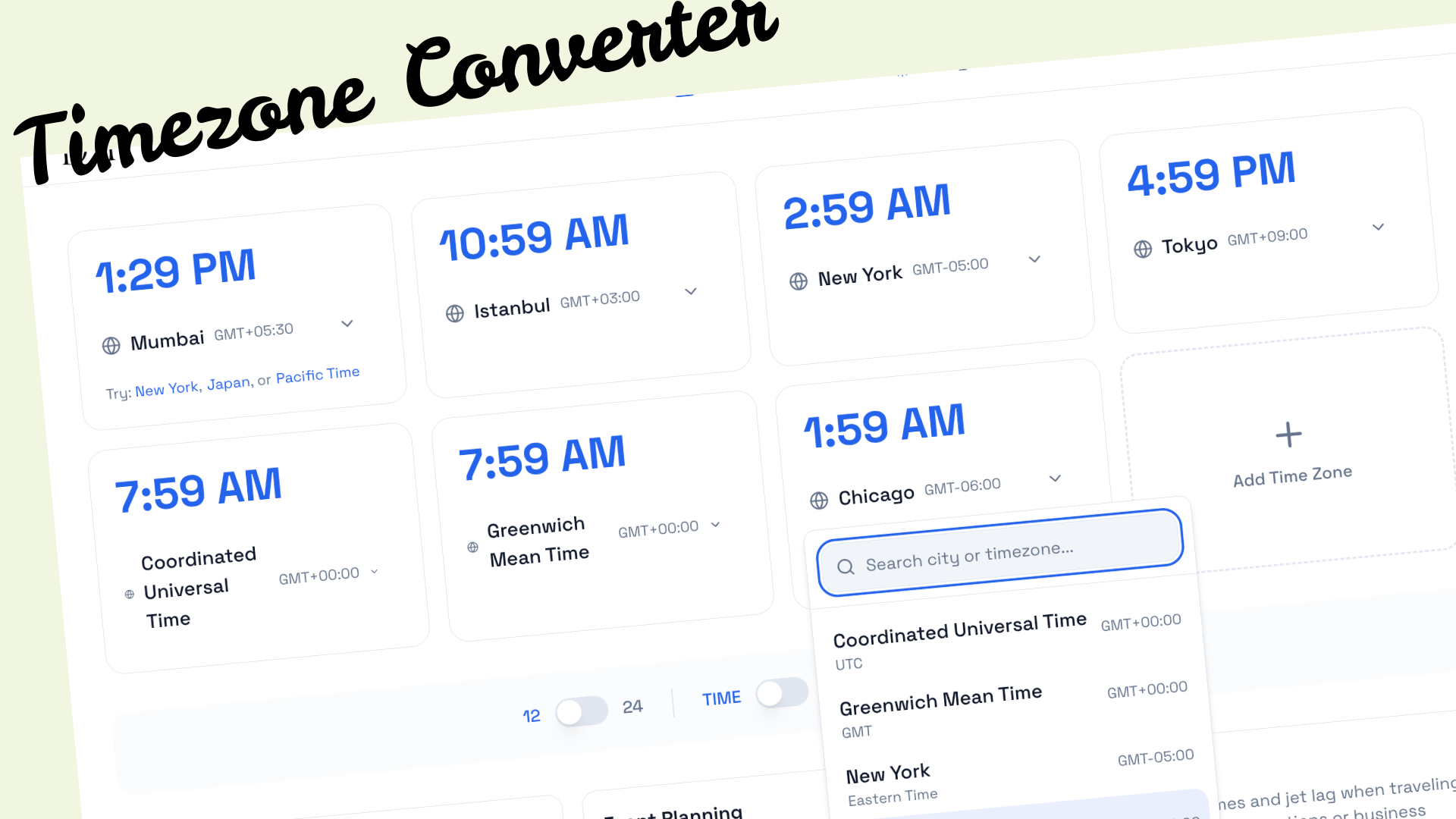
Instantly convert time between multiple time zones. Perfect for scheduling international meetings and coordinating across global teams.

Try: ,, or
Business Hours

Find overlapping work hours between New York (9-5 EST) and London (9-5 GMT) for scheduling meetings.

Event Planning

Convert event times for global webinars, conferences, or live streams across multiple regions.

Travel Planning

Calculate arrival times and jet lag when traveling across time zones for vacations or business trips.

Real-Time Conversion

Instantly convert times as you type. No need to refresh or click convert buttons.

100+ Time Zones

Support for all major cities and time zones worldwide with easy search functionality.

Share Instantly

Copy a shareable link with your time conversion to send to colleagues or friends.

Why Use Our Time Zone Converter?

For Remote Teams

Coordinate meeting times across distributed teams. Find the best overlap between different time zones for maximum participation.

For Travelers

Plan your journey and know what time it will be at your destination. Calculate flight durations and arrival times accurately.

For Event Organizers

Schedule webinars, live streams, and online events that work for participants across multiple time zones.

For Businesses

Manage international client relationships by knowing their local business hours and scheduling calls appropriately.
Complete Guide to Time Zone Conversion

Time zone conversion has become an essential skill in our increasingly connected world. Whether you are a business professional coordinating with international clients, a remote worker collaborating with teammates across the globe, or a traveler planning your next adventure, understanding how to convert time between different zones is crucial. Our free online time zone converter tool simplifies this process, allowing you to instantly compare times across multiple locations with precision and ease.

Understanding Time Zones: A Comprehensive Overview

The concept of time zones emerged from the practical need to standardize time measurement across different geographic locations. Before the adoption of time zones in the late 19th century, each city kept its own local time based on the sun's position, which created significant confusion for railway schedules and telegraph communications. Today, the world is divided into 24 primary time zones, each representing a 15-degree longitude segment of the Earth. However, political and practical considerations have resulted in numerous variations, including half-hour and quarter-hour offsets in some regions.

Coordinated Universal Time, commonly abbreviated as UTC, serves as the primary time standard by which the world regulates clocks and time. Unlike Greenwich Mean Time (GMT), which is a time zone, UTC is a time standard that remains constant regardless of daylight saving time changes. When converting between time zones, UTC provides a reliable reference point that eliminates confusion caused by seasonal time adjustments.

How Our Time Zone Converter Works

Our time zone converter utilizes precise algorithms to calculate time differences between any locations worldwide. When you enter a time in one zone, the system immediately calculates the corresponding times in all other selected zones, accounting for the exact offset of each location. The tool supports both 12-hour and 24-hour time formats, accommodating the preferences of users from different regions. You can add up to eight different time zones simultaneously, making it ideal for complex scheduling scenarios involving multiple international locations.

The interface design prioritizes simplicity and efficiency. Each time zone card displays the current time prominently, with the city name and GMT offset clearly visible below. You can click on any city name to access a searchable database of time zones, filtered by city, abbreviation, or full zone name. The search functionality responds instantly, allowing you to find and select your desired location within seconds.

Common Time Zone Conversion Scenarios

International Business Meetings: When scheduling a video conference between New York, London, and Tokyo, finding a suitable time requires careful consideration of each participant's local hours. A morning meeting in New York (9 AM EST) translates to early afternoon in London (2 PM GMT) and late evening in Tokyo (11 PM JST). Using our converter, you can quickly visualize these differences and identify windows where all participants would be awake and available.

Remote Team Coordination: Distributed teams often span multiple continents, making synchronous communication challenging. Our tool helps identify core hours where team members from different regions overlap. For instance, a team with members in San Francisco, Berlin, and Singapore might find that early morning Pacific time aligns with late afternoon in Europe and late evening in Southeast Asia, creating a brief window for real-time collaboration.

Event Broadcasting: Content creators and event organizers hosting global audiences must communicate times that viewers in different regions can understand. Rather than listing multiple times in your promotional materials, you can use our shareable link feature to create a custom URL that displays the event time in each viewer's local zone.

Travel Planning: Understanding time differences helps travelers adjust their schedules before departure, minimize jet lag, and coordinate with people back home. When flying from Los Angeles to Dubai, for example, the 12-hour time difference means that a midnight departure arrives in the early evening local time the next day.

Daylight Saving Time Considerations

Daylight saving time (DST) adds complexity to time zone calculations because not all regions observe it, and those that do often change clocks on different dates. North America and most of Europe observe DST, but their transition dates differ by several weeks. Many countries near the equator do not observe DST at all, as day length remains relatively constant throughout the year. Our time zone converter accounts for these variations by using current offset data that reflects any active daylight saving adjustments.

When planning meetings or events that occur near DST transition dates, extra caution is warranted. A time that works well in March might not work in April if one location has changed clocks while another has not. Always verify times close to the actual date of your scheduled event to ensure accuracy.

Major World Time Zones Explained

Eastern Standard Time (EST/EDT): Covering the eastern United States and Canada, including cities like New York, Toronto, and Miami, this zone is GMT-5 during standard time and GMT-4 during daylight saving. It serves as a primary reference point for North American business operations and is five hours behind London during winter months.

Pacific Standard Time (PST/PDT): The west coast of North America, including Los Angeles, San Francisco, and Seattle, operates on GMT-8 during standard time. With a three-hour difference from the East Coast, scheduling across the United States requires attention to this gap.

Greenwich Mean Time (GMT): Centered on the Prime Meridian in Greenwich, London, this zone serves as the world's baseline for time calculation. The United Kingdom, Portugal, and several West African nations observe this time.

Central European Time (CET): Most of continental Europe, including Paris, Berlin, Madrid, and Rome, operates one hour ahead of GMT. During summer, Central European Summer Time (CEST) moves clocks forward to GMT+2.

Japan Standard Time (JST): Japan maintains a constant GMT+9 offset throughout the year, as the country does not observe daylight saving time. This consistency makes scheduling with Japan relatively straightforward compared to regions with seasonal clock changes.

Australian Eastern Time: Sydney, Melbourne, and Brisbane observe GMT+10 during standard time, with Sydney and Melbourne moving to GMT+11 during daylight saving while Brisbane remains constant. This split within Australia requires careful attention when scheduling across the country.

Unusual Time Zone Offsets

While most time zones align with whole-hour differences from UTC, several regions use non-standard offsets. India Standard Time operates at GMT+5:30, placing it thirty minutes ahead of Pakistan and thirty minutes behind Bangladesh. Nepal takes this further with a GMT+5:45 offset, making it one of only three zones worldwide with a quarter-hour deviation.

Australia's Northern Territory and South Australia observe a half-hour offset at GMT+9:30, creating interesting scheduling dynamics with their eastern neighbors. Iran operates at GMT+3:30, while Afghanistan uses GMT+4:30, placing these Middle Eastern nations between standard hourly zones.

Time Zone Abbreviations and Their Meanings

Time zone abbreviations provide a shorthand way to reference specific zones, though they can sometimes cause confusion when multiple zones share similar abbreviations. EST typically refers to Eastern Standard Time in North America, but it could also mean Eastern Standard Time in Australia. Context usually clarifies the intended meaning, but specifying the city or GMT offset eliminates ambiguity.

Common abbreviations include PST (Pacific Standard Time), MST (Mountain Standard Time), CST (Central Standard Time), and EST (Eastern Standard Time) for North American zones. European zones use GMT, CET (Central European Time), and EET (Eastern European Time). Asian abbreviations include IST (India Standard Time), JST (Japan Standard Time), and CST (China Standard Time), which can easily be confused with the Central Standard Time used in North America.

The International Date Line

Running roughly along the 180th meridian in the Pacific Ocean, the International Date Line marks where each calendar day officially begins. Crossing this line eastward moves you back one day, while crossing westward advances you forward. This imaginary line zigzags to avoid splitting countries between different calendar dates, resulting in some interesting anomalies. Kiribati, for instance, adjusted its date line position in 1995 to ensure the entire country shared the same calendar day.

The International Date Line creates a fascinating time difference between neighboring islands. The Line Islands of Kiribati, at GMT+14, are the first places on Earth to welcome each new day, while nearby Baker Island and Howland Island at GMT-12 are among the last. Despite being relatively close geographically, these locations are separated by 26 hours.

Historical Evolution of Time Zones

Before standardized time zones, every city maintained its own local time based on solar noon. This system worked adequately when travel was slow and communication was limited, but the advent of railroads and telegraph lines in the 19th century demanded a more uniform approach. In the United States, confusion caused by multiple local times led railroad companies to establish their own time standards, eventually culminating in the adoption of four standard time zones in 1883.

The International Meridian Conference of 1884 established the system of global time zones we use today, designating Greenwich as the location of the Prime Meridian. However, adoption was gradual, with some countries not converting until the early 20th century. France, notably, did not adopt the Greenwich-based system until 1911, having previously maintained Paris Mean Time as its standard.

Political and Economic Influences on Time Zones

Time zone boundaries often follow political rather than geographic lines. China, despite spanning five geographic time zones, operates on a single Beijing-based standard (GMT+8) across its entire territory. This political decision means that sunrise in western Xinjiang can occur as late as 10 AM local time during winter months.

Some countries have changed their time zones for economic or political reasons. North Korea adjusted its time zone in 2015 to create "Pyongyang Time," thirty minutes behind South Korea, only to reverse the change in 2018 as relations with the South improved. Samoa made an even more dramatic shift in 2011, jumping forward by 24 hours to align with its major trading partners in Australia and New Zealand rather than the Americas.

Best Practices for International Scheduling

When working across time zones, clear communication prevents missed meetings and confusion. Always specify the time zone when sharing meeting times, preferably using both the local time and a universally understood reference like UTC. For recurring meetings, consider alternating times to share the inconvenience among participants in different regions rather than always accommodating one group at the expense of others.

Recording meetings and providing detailed notes helps team members who cannot attend live due to time zone constraints. Asynchronous communication tools reduce the need for real-time coordination, allowing teams to collaborate effectively despite significant time differences.

Technical Aspects of Time Zone Programming

For developers and those interested in the technical implementation of time zones, the IANA Time Zone Database (often called tz database or tzdata) provides the authoritative source of time zone rules worldwide. This database tracks historical changes in time zones, including past DST rules, boundary changes, and offset modifications. Programming languages and operating systems rely on this database to calculate correct times for any date in history or the future.

When storing times in databases or applications, best practice dictates storing timestamps in UTC and converting to local time only for display. This approach avoids ambiguity during DST transitions and ensures consistent behavior regardless of where the data is accessed.

Future of Time Zones

Debates about the utility of daylight saving time continue in many countries. The European Union has discussed eliminating DST entirely, allowing member states to choose permanent standard or summer time. Several US states have passed legislation to adopt permanent DST pending federal approval. These changes could simplify time zone calculations in some regions while potentially creating new complexities in others.

Some futurists have proposed eliminating time zones entirely in favor of a single global time standard, though such a change would face significant practical and cultural obstacles. For now, time zones remain an essential part of our global infrastructure, and tools like our converter help bridge the gaps between different regions of our interconnected world.

Frequently Asked Questions

How accurate is the time zone converter?
Our time zone converter uses precise offset calculations based on the current time zone rules. The times displayed are accurate to the minute and automatically account for the standard offset of each zone.
Can I convert times for future dates?
Yes, you can enter any time and the converter will calculate the corresponding times in other zones. However, for dates far in the future, be aware that daylight saving time rules may change, potentially affecting accuracy.
What is the difference between GMT and UTC?
GMT (Greenwich Mean Time) is a time zone, while UTC (Coordinated Universal Time) is a time standard. In practice, they represent the same time (UTC+0), but UTC is the technical standard used for precise time coordination worldwide.
How many time zones can I compare at once?
You can compare up to 8 different time zones simultaneously. This allows you to coordinate complex schedules involving multiple international locations. You can add or remove zones as needed.
Can I share my time conversion with others?
Yes! Click the "Copy Link" button to generate a shareable URL that preserves your selected time zones and the time you set. Anyone opening that link will see the same conversion.
Is this tool free to use?
Absolutely! Our time zone converter is completely free with no registration required. You can use it as many times as needed without any limitations or hidden costs.